
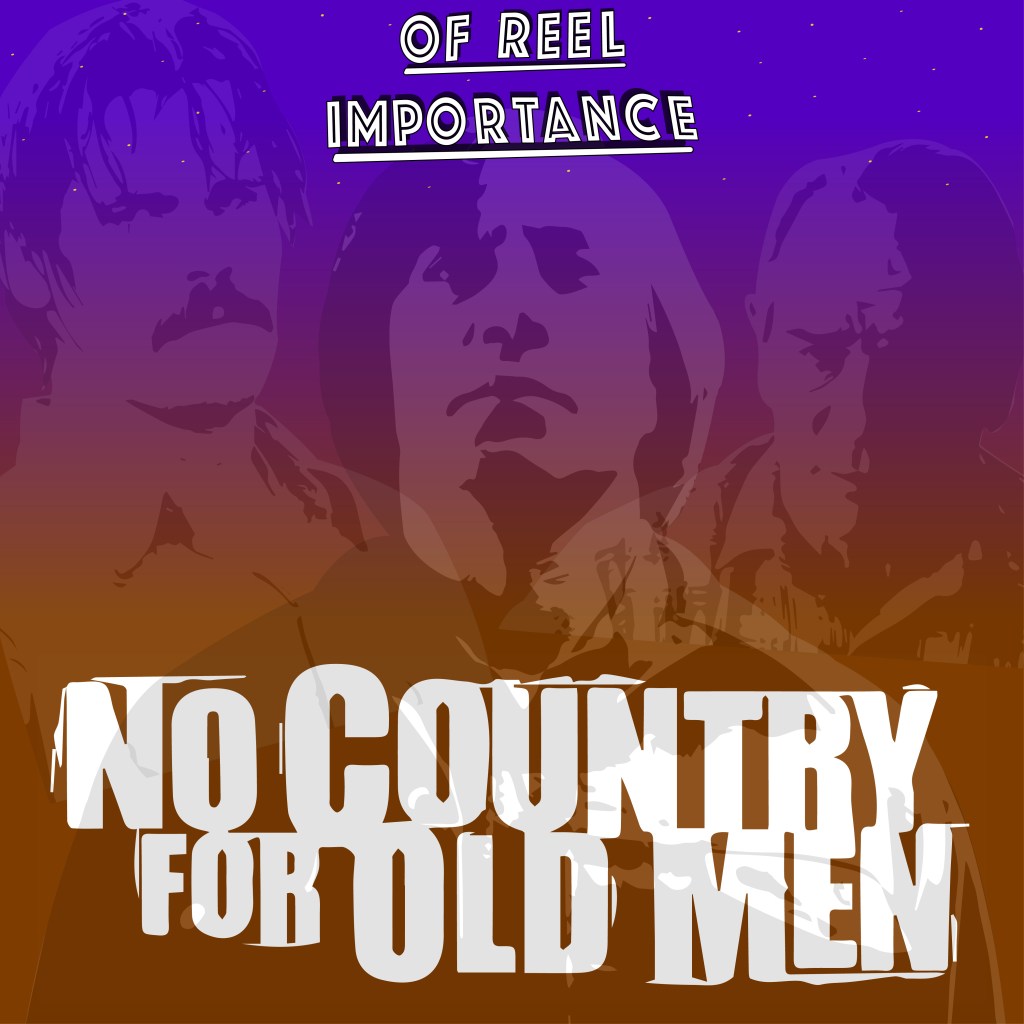
The Movie
No Country For Old Men is a movie from 2007 directed by Joel and Ethan Coen. It is based on a novel of the same title written by Cormac McCarthy. It stars Josh Brolin, Javier Bardem, and Tommy Lee Jones. The plot is (basically) as follows:
While out hunting in the west Texas desert, Llewelyn Moss (Brolin) stumbles upon what looks like a cartel drug deal gone bad. Upon his discovery, he finds a briefcase containing roughly two million dollars and decides to keep it. Moss and his wife then live happily ever after and peacefully die of old age, never dealing with the repercussions of his actions.
Just kidding. What really happens is Moss spends most of the rest of the movie trying to evade the various parties who are looking for the missing money, including a sociopathic hitman named Anton Chigurh (Bardem). Ed Tom Bell (Jones), the long-serving county Sheriff, is left trying to piece together the puzzle of carnage unraveling as a result of Chigurh ruthlessly murdering almost everyone who has the misfortune of crossing paths with him during his pursuit.
The Moment
In a movie that contains so many infamous scenes, it is difficult to choose one as the moment of the movie. Instead, I would like to choose every scene that contains the movie’s primary antagonist, Anton Chigurh. And, again, instead of talking about every scene that Anton is a part of, let’s just talk a little about Anton.
Along with possibly going down as the Coen brothers’ best film to date, No Country For Old Men gave us something else we’ve held onto since it was released. It introduced us to one of the most unique and terrifying villains we’ve ever seen on screen. Javier Bardem’s portrayal of Anton Chigurh instantly earned a spot in the film community’s bad guy pantheon and did so for a few reasons.
First: His haircut. This is one of his defining traits, unfortunately for him. It is equally as recognizable as it is concerning. But its importance goes beyond just his unsettling physical appearance. When you see a guy with a haircut like his, it tells you some very important stuff. It tells you that he, without a doubt, has no one in his life whom he loves or who loves him. And what I mean by that is:
- He has no wife, husband, girlfriend, boyfriend, partner, or love interest because nobody on earth would let their significant other get away with that haircut for any amount of discernible time.
- He has no close friends because if you have close friends and you get a haircut like that, your balls are going to get busted into eternity. Even after you no longer have the haircut, your friends will continue to make fun of you, and they will never let you forget the atrocity you once committed against your own head.
- He has no family – or, to say the least, no normal and loving family. People who are fortunate enough to have grown up in a household with a normal and loving family usually have the ability to make somewhat considerate and rational decisions. Anton Chigurh’s haircut is neither of those things.
Second: His weapons of choice. Every iconic movie villain has some sort of device they use to cause harm to other people, and this device is usually synonymous with their character. This is what makes them memorable compared to the rest. Anton’s chosen mechanisms of violence are two very distinct items.
- The first is a captive bolt stunner, which is primarily used to euthanize larger farm animals quickly and efficiently. It has a handle that is attached to an air hose that is attached to an air tank. Inside the handle is an oblong steel bolt that, when triggered, shoots out and retracts at a speed almost imperceivable to the human eye. Although we mainly see him use this device to blow the locks off doors, he also uses it once towards the beginning of the film on some poor bastard who was probably having a pretty normal day up until that point. The scene is shocking and unforgettable.
- His second signature weapon is a shotgun with a silencer attached to the barrel. He does most of his dirty work using this, and although it doesn’t seem like anything special, the sound it emits when being fired is so distinct it will haunt you. He often uses this weapon in very close proximity to his target, showcasing its brutality and power.
Last: His demeanor. Anton Chigurh looks, talks, and moves like a human, but has the mind and soul of something that is not. If you saw him from a distance, you might even think to yourself, “That looks like a completely normal human man (minus the hair).” But, as we quickly learn, this couldn’t be further from the truth. He seems to, in his mind, sit slightly above the rest of humanity, killing innocent people and having no second thoughts about it like a child stomping on ants. He lives by his own set of morals while having a complete disregard for human life, and this makes him nearly impossible to predict. There is really only one thing you can count on if you were ever to have the displeasure of meeting Anton: you will more than likely not live to tell anyone about it. This is made abundantly clear on multiple occasions throughout the movie.
- Once, by Anton himself after he shows up to the office of the man who hired him and kills him in the middle of a workday. When he does this, there happens to be another man in the room who says he’s an accountant. The accountant is horrified after witnessing what Anton has just done and proceeds to ask, “Are you going to shoot me?”. Anton, being the wisecrack he is, responds by saying, “That depends. Do you see me?”. Now, I know it’s unclear whether or not Anton actually does kill this guy because we don’t see it on screen, but come on, I mean, look at who we’re dealing with here. Given his track record and the devilish smirk he wears when answering the question, I think we all knew the fate of the accountant.
- Another time is when Carson Wells (Woody Harrelson) pays a visit to Moss after Moss ends up in the hospital after a violent encounter with Anton. Wells is genuinely surprised to learn that Moss actually laid eyes on Anton and lived to tell the tale.
Add all of these qualities together, and what do you get? You get Anton Chigurh. Is getting Anton Chigurh a good thing?
In real life: No.
In movies: Absolutely.
The Score
With almost any movie, the score is one of the most vital elements. If a movie was a human body, the plot would be the brain, and the music would be the heart. If one isn’t functioning correctly, it is devastating to the rest of the body. If someone had told me before I watched No Country For Old Men that there was practically no music throughout the entire film, it might have dissuaded me from even watching it at all. But, as we learn, not having a score is so crucial for a movie like this. The silence is the score. It adds a specific tension to the story that music cannot create. It puts you on edge because it feels unnatural. You might not even notice it at first, but something is absent from the atmosphere of each scene – something you subconsciously expect to be there. It’s discomforting, to say the least.
I imagine it’s similar to how it would be if you were riding shotgun in any of Anton’s various stolen vehicles he commandeers throughout the movie. He spends a lot of time driving, and during these scenes in which we see him driving, there is nothing but silence inside the car. I realize that early on he is listening to the quiet beep of the transponder, so it doesn’t make sense for him to be listening to anything else. But even after the transponder is no longer in use, I find it extremely unlikely that he has the radio on at any point during his numerous road trips. No music, no talk shows, no sports, just complete and utter uncomfortable silence. I mean, what would he even listen to? What would Anton Chigurh’s Spotify Wrapped consist of? Who were his top 5 artists of 1980? What were his most played songs? What was his minute count? Just imagine how much more we would know about his character if he could’ve shared this information on Instagram like the rest of us losers. I also wonder how different his conversation with the man who owned the gas station might have been if the man had asked him, “So, what kind of music are you into?” Anton would’ve probably just killed him right there on the spot for asking such an absurdly stupid question. No coin toss and no other questions asked.
Explain this to me
Since this movie is based on a novel, it’s likely that many of the lengthy details were left out to save time. And since I have not fully read the novel yet, I have some questions that may or may not have answers. For instance:
Why was Anton being arrested in the opening scene? Was it his intention for that to happen? I’m sure he could’ve taken down the police officer on the side of the desert highway just as easily as he did when they arrived at the police station, and it probably would’ve saved him some time in the process.
Also, did the man who hired Anton (that’s literally his name in the credits) not know anything about what a complete lunatic he was? It seems Anton wasn’t vetted for the job at all. This leads to the man making a huge mistake in hiring more guys to do Anton’s job, which Anton views as a betrayal, which ultimately leads to the man dying.
Last, and maybe most important, did Sheriff Ed Tom Bell even want to catch Anton? In other thriller-type crime movies, his character’s role is meant to be a hero. He is chomping at the bit to find the bad guy and give him justice. He is up day and night and is unrelenting in his efforts until he can achieve this. Although this type of character makes for a fun movie and gives the audience someone to root for, it can feel unrealistic at times or, even more so, un-relatable. This movie does not have that character. Instead, we have Sheriff Ed Tom Bell. Sheriff Ed Tom Bell is obviously someone you’re rooting for, but in all reality, you’re just rooting for him not to die – plain and simple. He is always just a few steps behind Anton, but never feels like he has the sense of urgency he should to catch up with him. And honestly, who could blame him? I wouldn’t want to catch up to Anton Chigurh, either. It’s summed up perfectly within the first 5 minutes of the movie. We hear Ed Tom’s voiceover while Anton is being arrested, and as we see the shot of the bolt stunner (Anton’s signature weapon) being put into the police car, Ed Tom is saying, “I don’t want to push my chips forward and go out and meet something I don’t understand.” Me neither, Ed Tom.
The Takeaway
There are many takeaways from this movie, as there are with any movie. Some small and some big, but all of them are important. A few that stuck out to me:
- Don’t interact with anyone who has Anton Chigurh’s haircut.
- Probably don’t take two million dollars from a crime scene with 7+ dead bodies.
- If you hire Anton Chigurh for any job, there should be at least three rounds of interviews as well as a Myers-Briggs test given on-site. You should also ask for a strong list of references, which he will not be able to give you because all of his references are most likely dead. Because he killed them.
- Getting old sucks, and the world doesn’t care about your feelings. This is the one I want to spend a little more time on since I believe it is more or less the main theme of the movie.
Every generation – from when they’re born to when they die – watches the world change into something less familiar to them. This has happened since the beginning of time. The world is ever-evolving, and we do our best to keep up with it. Unfortunately, there comes a point when this is no longer possible. Eventually, we all slow down because that’s what the human body does. And when this happens, the world gets scary.
When Ed Tom visits with his cousin Ellis towards the end of the movie, he tells him the reason he is retiring is that he feels “overmatched”. He is worried that after everything he’s just witnessed, he will no longer be able to do his job competently because the landscape has shifted so dramatically from what it used to be when he was younger. Everything he used to know about his line of work is now different, and he no longer understands it. More importantly, he no longer has the stamina to try and understand it. While this is true, it “ain’t nothing new” as Ellis so coarsely puts it. He continues by basically saying the world has always been a hard place and it continues to move forward regardless of anyone’s feelings. The problem is that we as humans always blame the world around us for changing instead of our inability to change with it, especially as we age. The acceptance of mortality is tough, and this is the main battle Sheriff Ed Tom Bell faces throughout the movie. It also doesn’t help that he probably saw more dead bodies in the span of three days than he did during his entire tenure as the county Sheriff. Thanks, Anton. Either way, the message remains true, and it’s even backed by the title of the movie – No Country For Old Men.
Have you seen this?
I asked my wife this question one morning after watching No Country For Old Men the previous night while she was in bed. She said she had never heard of it. To some, this may be confounding since the movie won four Oscars: Best Picture, Best Director, Best Adapted Screenplay, and Best Supporting Actor (Bardem, of course). I, however, was not so surprised given her peculiar taste in movies. Allow me to shed some light. Her top 3 favorite movies of all time (in no particular order) are as follows: The Greatest Showman, Sweet Home Alabama, and Legally Blond. If you have seen any of these movies, you may have noticed a common thread. The common thread is that they all involve a great deal of smiling, laughing, and genuine happiness. Sure, they each have their conflicts that the characters must overcome, and these parts are not filled with the previously mentioned characteristics, but each movie also contains the most vital element of any good movie according to her: a happy ending. Knowing this, I kindly asked her if she would watch No Country For Old Men on her day off and report back to me her thoughts on the movie. To my surprise and delight, she obliged. The following is a text exchange between her and I while I was at work and she was at home watching the movie:
Me: Did you watch it?
Her: Almost
Her: Had to run to TJ Maxx
Me: What’d you get?
Her: Just some stuff
Her: I’m watching the movie now
Her: I’m 8 minutes in
Her: And I’m confused about which part of this movie you thought I would enjoy
An hour later:
Me: Are you still watching?
Her: I’m taking a break to fold laundry
I believe no further explanation is required on how my wife felt about No Country For Old Men. When I got home later, I asked her what she didn’t like about the movie and her response was, “I didn’t like any of the characters and I didn’t like the story.” I guess those are important factors when deciding whether you like a movie or not. And to her, for putting up with me and my dumb requests, I will borrow a line from Sheriff Ed Tom Bell which he sweetly utters to his wife towards the beginning of the film.
“I love you more and more every day.”
 The Hollow Muse